The 3 Guitars On the Stand Today

Figured I’d tell you about the 3 guitars that are out on the stand today. Or more accurately, hanging on the wall today.

Epiphone IBGC 1959 ES-355

The first is the one that, for the last year, is the one I generally grab. It’s my IBGC ES-355. Picked it up May a year ago. Mrs Snarf knew I wanted one, so she told me I should get it as a happy-new-job present to myself. She didn’t have to tell me twice.

I’ve always dug the sound of a good semi-hollow. This one is, imho, Epi’s top of the line for those. It’s a really great guitar. It’s got those Gibson Custombucker pickups in it that sound really, really good to my ear. The neck on it just sings. It’s satin red. It’s got the fancier binding and inlays. And my #1 fave thing about it is the big neck.

I bought it mainly because of the neck and pickups. They haven’t disappointed. In fact, I had a real, live GIbson ES-335 for a few years. It wasn’t a bad guitar, but it was definitely a Friday afternoon guitar. There were some things about it that just…weren’t right. It eventually got traded off. Adjusting for inflation, there was a $1,300 difference in the two guitars. In the case of these two, the less expensive one has turned out to be the better instrument.

Sounds good. Looks good. It’s been my main player since I bought it.

Epiphone 1962 50th Anniversary E212T

Next up is my 1962 50th Anniversary Sheraton. It’s number 240 of 1962. It was the original guitar I bought trying to scratch the 335 itch. I probably don’t talk about this one enough. It probably deserves its own post someday. For several reasons, it didn’t really scratch the itch, but, when I had the real 335, the Gibson went away, and I still have this one.

It’s got a super skinny neck on it. That’s probably the thing I dislike most about it. However, the pickups in it more than make up for the toothpick neck. They’re Gibson mini-humbuckers. I’ve never been able to put my finger on why I like them so much. If I had to give a description of them, I’d say they’re just super smooth.

It had actually been in the closet until a couple weeks ago. I picked up the Les Paul to play it for something, and the sound wasn’t right. So I grabbed the 355, and it still wasn’t what I was after. So I grabbed the Tele, and that was strike three. So I went to the closet. Went to grab a couple others, but grabbed the Sherry instead. That was it! The sound in my head for what I was playing.

Also, I don’t typically like gold hardware on a guitar. To me, that’s the worst thing about my 355. I just am not a gold fan. However, on this Sheraton, the gold looks really nice. Imho, it’s a really good looking guitar. Looks and sound…a killer combo,

Fender Road Worn 50’s Telecaster

I’ve talked about this guitar before. It’s my Road Worn 50s Tele. I wasn’t really a fan of it until I stuck those Bootstrap pickups in it. After I did that, it has stayed in constant rotation.

Not a whole lot to say about this one that I haven’t already said. It sounds like a Telecaster should sound. Looking back at the original Road Worn 50s Tele that had (from 2010), I would’ve probably kept that guitar if I had changed the pickups in it. But I like the look of this one a LOT better.

The only thing I liked better on that other Tele, weirdly enough, was the look of the neck. Those original Road Worn maple necks got a LOT of the anti-relic crowd all riled up because the frets looked like they had been through it. In fact, when I traded the guitar in, the guy at the store said, “you played the finish off this neck.” I hadn’t. The finish was still on there, it just looked like it wasn’t. Again, weirdly enough, I really dug the neck because of the fact that so many people didn’t like it.

The neck on the Road Worn I have now is worn in the back, but the frets don’t look like they’ve been beat to heck like that other one. The overall relic job is, also, not as relic-ed looking. Makes me think that over the years they toned down on the relic process.

But it’s a great guitar as well. Sounds good. Looks good. I enjoy playing it.

So what guitars are you playing right now? Anything cool and interesting and different?
My Pick Journey

Up until about 15 years ago, I had never been a big pick user. I played mostly with my fingers. Decided that I needed to try using picks, so I went to a local guitar shop and picked up about $10 worth of picks. I came home with probably a 12 or 15 of them.

I tried them all and settled on Dunlop Gator Grips. 1.5 was the gauge that seemed to be what I liked. I played those for probably 10 years and shifted over to the 0.96 gauge. That’s what I’ve been playing for the last 5 or so years. With my acoustics, I would generally shift down to 0.71, but, since I primarily grab the electrics, it’s the 96s.

It’s weird, I seem to like the stiffer pick for the slinkier strings and the slinkier pick for the stiffer strings. Depending on the acoustic, I play either 12s or 13s. For the electrics, I play 10s across the board.

Last Black Friday, I bought a JHS pedal. It had a Gravity pick in it. I’d never seen one before. I initially set it aside because it reminded me of the V-picks. I had picked up one of those like 10 years ago. I really tried to like it, but it just did nothing for me. Then I bought the Not-A-Dumble. It had one of the Gravity picks in it too. As I pulled it out of the box and set it on the back of the desk with the other one, I thought maybe I’d strum a chord or two with it. I’d never done that with the one I got last year.

Turns out I really like it. It’s the one that I’ve been using the last couple of months. It doesn’t feel or sound like the Gator Grips, but I like it.

According to the website, it’s a 1.5, but it feels thicker than the 1.5 Gators. I feel like I can hear it on the string where the Gators don’t have that same “plink” when it hits the string. To my ear, it also makes the guitar sound a little brighter. Definitely different, but I kind of like the differences. Where it’s the same (but different) is that I like the Gator Grips because I don’t feel them slipping between my fingers when I play. The Gravity picks seem to stay in place too.

Will I keep using them? I have no idea. Over the last however many years, it seems the only thing that stays the same is that I eventually change. But right now I’m really digging the Gravity picks. They’re like $6 a piece! That’s crazy to me. But even at that, I think I might pick another couple up just to be sure I have them. After all, I occasionally lose picks, and JHS has said that, in a cost cutting measure, they’re not going to be including them anymore. So get a couple while I can I guess.

When Is a C Actually a D?

So lately, I’ve been working my way through a course. I have discovered over the years, that, when I’m working on an online course, I will blast through it and learn the material. When I get done with the course, I can play the material. Looking back, however, sometimes I don’t take the time to really learn the ins and outs of the material.

I decided I’m going to try to change that a bit a little on the course I’m currently working. Then again, I almost have to. I’m not calling it a jazz course, but it’s definitely more in that vein. Given where I bought the course and what they primarily teach, I think the rest of the world would call it jazz.n In fact, if you saw my last post about online teachers, I’m actually working a couple of courses simultaneously. One is from the jazz guitar website I mentioned, and the other is a course that Griff (from BGU) started me into when we were doing private lessons and I told him I would like to put a little Larry Carlton into my playing.

Here’s what I’m currently trying to wrap my head around. It’s something that Griff and I talked through at least a couple of times. I feel like I understand it in my head, but I can’t get it to go into my fingers and musical vocabulary. It’s the theory of things.

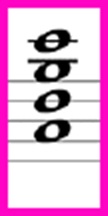
I’ve always been a pretty black and white person. 1+1=2. C comes after B which comes after A. That kind of thing. Then, in my playing, I run across something like this. Take a look at the pic below. What chord is that?

Notes on a staff showing an A, D, G, and C.
What do you call this?

Now here’s why Griff and I had the discussions. In the course I’m working through now, it shows that same chord in 2 different places. However, in one place it calls it a Dm11. In the other it calls it a C 6/9. It’s the same notes, so how can it have more than 1 name? Inner me is screaming.

It’s context.

That’s what Griff tried to pound into me. I knew he’s right, but I can’t seem to get it past my head to where I truly understand it. Conceptually, I guess it’s like James being called Jim, Jimmy, Jimbo, J-dawg, Junior, Bubba, or whatever folks happen to call him. Same guy, different names depending on context. One reason I’ve always liked music is because it’s very ordered. Like math. 1+1 always equals 2. Instead of 10, it repeats after 7. Structure is its thing. Until it’s not and you hit something like this.

Half the problem with the example I give, however, is that both instances of the chord are in the same song. That’s where the context of the chord gets important. And, weirdly, they’re both in a ii, V, I progression. If they weren’t, I may not’ve noticed them. In on spot, it starts the progression and ends it with a C Maj7. When it comes back around, it starts with a Dm7 instead, and then uses this chord to end it.

That’s where my head explodes a little bit. As a guitar player, I often fall back on the pattern I played or the fingering of the chord to say what I did. Since it’s the same notes, I’m going to play that chord the same way everytime. But, if somebody asked me what I was playing, is my brain going to be quick enough to recognize it as the ii and call it a Dm11 or am I just going to look at the key of the song being in C and that fingering being a C 6/9 and call it that even if that’s not the function it’s playing?

That’s the kind of thing I hope to be able to do one day. Until then, if you’re every playing with me and ask me what a weird chord is, I may call it the wrong thing. To be so simple and straight forward, music is awfully complicated sometimes.

Online Teachers

Like a lot of guitar players, I probably spend way too much time surfing the web and looking up all things related to guitars. I like to see the new shiny gear. I like to hear the guitar talking heads talk about whatever they’re talking about. And I like to see what I can learn from some of the online teachers.

I’ve followed a LOT of the online folks at some point for at least a little bit over the course of the last however long. Marty and Justin and Doug Seven and Stevie Snacks (now Texas Blues Alley) and Bob Murnahan and Corey Congilio and Jim Lill and Edina Balczo and so many others. Quite a few of them I’ve even bought lessons from once or twice. And that’s not even counting Truefire and some of the other bigger sites. I’ve got enough lessons that I could probably make a full time job just working my way through them for a couple of years.

There are two that I currently follow because either their style of teaching or what they’re teaching seem to resonate with me. So here are two or three paragraphs on each of them.

Griff Hamlin and Blues Guitar Unleashed. I found Griff in either late 2009 or very early 2010. I bought my first course from him in January 2010 after I stumbled on his 4 Note Solo video. I’ve followed him closely ever since. When he opened up what he calls his All Access annual subscription, I jumped on it, and I’ve never looked back. His style of teaching fits my style of learning. He’s also a great teacher.

His flagship Blues Guitar Unleashed course is the first one I bought. It’s also the first course I actually sat down and spent weeks, even months, working through until I got distracted. I made it probably 3/4s of the way through it. Granted, by my own admission, a lot of what I had learned was still really shaky, the first half was a good enough basis that, adding it to what I already knew, I could continue to build on it over the coming years. The first half of the course laid the foundation that you need to play blues and, arguably, most styles of modern music. The second half is a collection of 6 solos that are used to solidfy and ingrain what you learned in the first half. I got distracted after the 3rd solo because the solos became beyond my ability to play. I really should go back and learn them now.

When I bought that course, Griff had 2 courses. That one and a course for brand new players. It didn’t take long before he was putting out 2 or 3 courses a year. I would buy them when he released them. Now he has All Access, and, to me, since I like him and his way of teaching, it’s something that I will subscribe to as long as I can afford to do so. All Access is exactly that…gives me access to every course he produces.

I’ve also had the privelege of meeting Griff, attending some of his jams, and I’ve taken a few face lessons with him. He’s a stand-up guy.

Jazz Guitar Online. This one is a bit newer to me. I think I found them 2 or 3 years ago. I found it mostly because Griff doesn’t have a jazz course. In one of our face lessons, he had pointed me a direction that I really enjoyed using a Herb Ellis book, and that made me want to dive a little deeper. I heard a couple of arrangements of some songs that had that jazz sound but didn’t sound over my head, so I found where they came from and downloaded them to learn. They came from this site.

I downloaded those couple of songs. Then I downloaded their Beginner’s Guide to Jazz. I think that course was free. Admittedly, I’ve looked through that one once or twice, but I never really started into it. However, on a whim, I recently bought their Complete Chord Melody course and started working through it. Like that original BGU purchase, this one has me working my way through the whole thing. I sometimes struggle with some of the theory in it (I’m a blues and rock player at heart – theory? we don’t need no stinkin’ theory!), but the voicings and stylings the course have been showing me are just super cool. They make me feel like a jazz cat.

This course isn’t like BGU where a teacher talks you through everything in the lesson, then gives you a play along, and then let’s you play it on your own. It’s primarily a read and follow the examples course. And, since I’m a monkey-see-monkey-do learner, it’s taking me a bit longer to try and read my way through. But the subject is super interesting to me right now, so it resonates because of that.

Talking about these two is not me trying disparage the others in any way. The others have all been good, and I can probably point you to something that I’ve learned from each one. I just think these two are the standouts.

What about you? What online teachers have you used with success?

I bought a Notadumble

I bought a Notadumble. When JHS announced it, I was actually excited to hear about it. You see, my always-on pedal for the last few years has been a D-type.

I’ll admit. I have no idea what a Dumble sounds like. I know that it’s supposed to be the Robben Ford sound. I, also, know that several other big name players have and use them. But I have never seen an actual Dumble that I am aware. And, in a blind test, I know I would have no hope of picking one out of a pack if I heard one. At least not without a LOT of blind luck on my side.

So why do I say that I was excited? Remember those always-on pedals? I use the ones that are D-type because I like they way they sound.

I picked up a Nux Steel Singer on a whim several years ago to add to my afford-a-board. It was the first pedal that I bought that was a D-type. I got it used on Reverb for $27 shipped. The afford-a-board has gone away, but that pedal has stayed. It now sits on my smaller board between a Wampler Germanium Tumnus and a JHS Harmonic Trim at the end of my drive options. On my big board, I run a Warm Audio Warmdrive. I think it’s actually supposed to be a copy of a Hermida Zendrive, but he uses a Dumble, so it qualifies. It sits between my KTR and a Boss Trem pedal. I dig them both!

When JHS announced a D-type, I knew I’d be getting one. They may’ve already had one; I really have not idea. But I like the whole Not-a-concept pedals. The first one was fun to put together, and they’re relatively cheap in the pedalverse. So, when I saw the email that they were available, I pulled the trigger.

I like it! I prefer the drive “channel” of the two tones it has. I haven’t paid too much attention to what the sections are supposed to be. The clean “channel” sounds really nice, and it’s probably the one that’s a little closer sounding to how I have the always-on pedals set. But the drive side is really nice to my ear and probably the one that I’ll use most often.

Then came the controversy. Did Mr JHS really make a mistake or just make something to sell to the suckers? I have no idea. I have no reason to not trust his explanation of what happened. In fact, I can easily see what he explained happening. To me, it is easily a plausible series of events that took him from point A to point C instead of point B.

But, whether it was a genuine mistake (I tend to think it may’ve been) or I have been outed as a sucker, I like the pedal. So it doesn’t really matter to me. Also, I don’t have either original pedal the circuits are from, so I have no idea what one or the other is supposed to sound like. The pedal sounds good! I’ve actually been sitting here trying to decide if it’s going to be the one that finally boots the Nux off the board.

I see that some idiots are trying to sell theirs on Reverb for $300 or more. What’s worse, looking at the Transaction History, I see that other idiots are actually buying them. Yeesh! I’m not selling mine. At least not for a while. It’s a good sounding pedal. Why not use it?

Does it sound like a Dumble? I have no idea! Am I bothered because it doesn’t have the circuit originally advertised? Since I have no idea what the original pedals sounded like, the answer is no. Will I be buying the V2 whenever it comes out? I couldn’t tell you right now. I like this one, and, on the “I’m sorry” vid, I couldn’t tell much of a difference in the pedals. So, ask me after it’s announced and available.

And in a pivot to other pedals, I’ll mention that I already have a couple of those clones Behringer is making now pre-ordered. I’m a sucker for a good Klone, so I have that one ordered. And I dig a good vibe, so I have that one ordered. Sadly, I didn’t order them before the dang tariffs went into affect, so they’re costing me like $20 more than they should’ve, but they’re both ordered. The voicemail I got the day I ordered them said I might have them in hand the end of June. I’m looking forward to see if they live up to expectation.

Guitars I Play

Today I’ll talk about the guitars that kind of rotate in and out of play. I guess that would qualify them as my favorites.

First, the one that has been my primary player for the last year. It’s one of those Epiphone Inspired by Gibson Custom Shop ES-355 models. I got it right at a year ago as a “happy new job” present. Love it!

Here are the things I like about it. The neck is perfect on it. It’s a satin red instead of gloss. It has Gibson CustomBuckers in it. The neck pickup, by itself, sounds A.Mazing. Having gone through a couple of other Epi 335s and Gibson 335s, this is the version of those that I think I always wanted.

My primary player before I got the 355 (and still could easily be) is my Epiphone Standard 50s Les Paul. Weirdly, I bought it on a whim. I always thought a gold top LP looked really cool. I had just been through the great gear purge of 2020, so I had some extra gear money laying around. I saw this one on AMS as a blem for like $150 off. So I bit.

I have no idea why it was a blem. It was perfect when it came in. The ProBucker 1&2 that were originally in it sounded really nice (especially the 1 at the neck). The neck on it is what sold me on the 355 I have…I think they call it the 50s C. Whatever it is, it’s the perfect handful for me.

I eventually swapped the ProBuckers out for a BurstBucker 1&2 just to see if it sounded any different. I didn’t like the neck as much, but the bridge sounded better. Also, the BBs were a tad hotter than the PBs. I have stuck with the BBs. This is the guitar that I generally grab if I’m playing out and I’m playing an electric.

One more to go into a little detail, and then a couple of honorable mentions.

Next is my PRS Custom 24 SE. I got it for 2 reasons. First and foremost, it’s hot pink. I think the official color was bonnie pink or something like that. But it’s hot pink. And that’s my second favorite color in the whole wide world, so I had to get it. Second, I had always been curious about PRS guitars.

So I picked it up a couple years ago. It’s a great guitar. Changed out the knobs to be bright yellow (my favorite color in the whole wide world), but that’s all I’ve changed. Out of the box, it was as good as I could imagine. Honestly, the fit and finish were (and still are) impeccable. It plays really nicely. It has coil-splitting. Weirdly, I have never used coil-splitting on any guitar I’ve had that included until this one. The humbuckers on it, to me, just sound average. They don’t stand out in any way. But do the coil split thing, and it’s the first humbucker guitar that, split and in the middle, kind of leans in that Strat-spanky sound. Also, did I mention that it’s hot pink?

Now for the honorable mentions. These get pulled out occasionally, but always end up getting replaced by one of the others.

My Gibson ES-339 in caramel burst. I actually really like this one. The size of it is great, and it sounds really nice. I think my biggest problem playing it is that it took my soooo long to find it (seriously – a couple years of looking) that I’m afraid I’m going to mess it up. It looks good. It sounds good. I’m not sure what else to say about it.

My Fender Road Worn 50s Telecaster in purple. I, honestly, think I got the last one of those that was available new (which is a story I think I’ve talked about before). I never really loved it. I had the same problem with it that I had with the Telecaster I had before it. It just sounded so…generic. Then I swapped the pups out, and it came alive. The neck on it is like a toothpick. Otherwise, I’d probably play it a LOT more than I do. It’s another one that I would gig with just because it’s not going to hurt my feelings if something happened that dinged it up.

My Epiphone ES-335 Traditional Pro. Got this one and really liked it. The jack fell into the guitar, so I took it to a luthier to fish it out. While he had it, I had them replace the Alnico Pro pickups with coil-tapping out for a regular set of 57 Classics that I had sitting on the shelf. It honestly doesn’t sound that different. But it’s the 335-type that I played until I got the 355.

Those are the guitars that I play regularly or on a somewhat regular basis. In the closet I’ve got at least a couple Strats, a Parker, a Gretsch, a couple of other Teles, a Dano copy of a Mosrite, and several acoustics. All of them are great guitars. I guess anyways. I don’t seem to play any of them often enough to know for sure.

But I still buy on Reverb

I saw a vid a couple weeks ago that made me stop and think. Well, not much, but it just kind of confirmed something I had been thinking. Long and short is that I don’t really sell anything on Reverb anymore. Heck, I’ve got a box of pedals over there that I need to get offload, but I’m not doing it there.

For a while, I had started selling quite a bit there. It was kind of nice to buy some gear, try it out, and then sell it for some other gear. The fees always kind of bothered me because they were a little higher than I would’ve liked. But whatever right? It was an easy way to get into that buy and try and fly circle.

But then last year (or the year before) Reverb started doing the 1099 thing. I’m not a business. I’m not trying to make money buying and selling gear. In fact, since it’s all used, I don’t never took a bath on what I sold, but I never made money on anything. That wasn’t the goal. So I don’t want to be treated like it’s a business and taxed on it. Or, since I had to pay tax on it when I bought it (because I’m not a business), I guess there’s the possibility of a piece of gear being double-taxed.

So I tried an experiment.

I knew that, by the time I was a nice guy and dropped the price and few bucks and then the fees and shipping were taken out, I was pocketing about 70% of what I sold it for. I heard my local GC was advertising that they give 60% of what they will sell the gear for. So I loaded up some gear and carried it to them.

I put together a spreadsheet of what I thought they would sell it for and what I hoped I would get. I actually got a good bit more. So I either guessed low or they gave me more than 60%. Either way, I felt like I made out like a bandit.

I got home and realized that I had gotten almost what I would’ve gotten on Reverb, but I didn’t have the headache of having to deal with people wanting to low ball me nor having to pack and ship anything nor just hoping that when it arrives the purchaser doesn’t decide to say I sent a broken pedal.

So I decided that from now on, that was how I was offloading gear. I have a GC about 15 minutes away, a MusicGoRound about 30 minutes away, and about 5 more GCs within an hour. So, no more selling on Reverb. I still buy there all the time. Heck, I got a pedal in this last week. But no more selling.

Here’s the vid I saw. What the guy describes is pretty much my take. Take it to the GC. My experience has been that they will give a discount on gear that I buy with the trade. So, since the money always goes back into the gear budget, between the little bit lower amount that I receive and the discount on the new gear, it ends up being about a wash.

I always eat at the same restaurants

In a former life, I was GM of a mom and pop burger joint. Burgers and fries were our big sellers and what folks knew us for, but we also sold chicken fried steak and a couple things like that. While I was there, I read a couple of industry mags every month. I remember reading several articles that talked about how most people went to go to the same 5 to 7 restaurants the vast majority of the time. Even today, all these years later, I’m reminded of how accurate that is when I swing through one of the same 4 or 5 places that I seem to go to all the time. We’re creatures of habit.

This week I was catching up on some of the podcasts that I listen to. Like a lot of guitar players, I enjoy listeing to the Chasing Tone podcast. I’ve enjoyed Brian and the boys since it was Brian, Max, and Travis. Max and Travis have been gone for quite some time now, but I still enjoy Brian and the new guys (that aren’t really new anymore).

One of the epis that I heard this week had Tim Pierce on it. I’ve always liked his stuff on the tube of you, so I thought I’d listen in. Kind of like Brian, Tim has always struck me as someone that really knows his stuff and is a genuinely nice guy. And, in this interview, my opinion of him didn’t change. He seems like a class act.

Somewhere during the podcast, he made a comment that struck me. I was at work, so didn’t make a note of where in the podcast it was, and, since I went through like 3 epis that day, I have no idea where in the podcast it was. So you’ll just have to listen to it to hear all of his comments. It really was an interesting interview.

Somewhere in the episode, Tim got to talking about using modelers and some of the newer tech like the Helix, Fractal, and Tone Master Pro. He said that most folks find 3 to 5 sounds on modelers and stick with those.

In my experience, he’s not wrong.

I know that I’ve got my pedal boards, but I’ve been trying to use my Pod Go more. Mostly because it’s been a while since I’ve used it playing out, and I don’t want to pull it out a gig sometime and realize that I don’t remember how to change something I need to change. So I’ve actually been looking at my presets lately. And I’ve got 3 banks of 4 presets, with each bank being based on a different amp.

The first bank is using Line 6’s Litigator amp, the second is using a Fender Twin, and the third is using a Bassman in 2 spots and an AC30 in 2 spots. Each bank has 4 presets. Each preset is setup for a different guitar. The first two banks are setup for my LP/335, my PRS, a Tele, and a Strat. The third bank is setup for humbuckers for one and single coils for the other. Other than that, they’re all pretty dang similar. And the vast majority of the time, I’m playing the Litigator bank. Just kind of proving what Tim said.

That’s not to say that I don’t have other banks with other settings. I do. I’ve got probably half the banks filled with different things. Marshall, Matchless, Dr Z, and various other IRs that I’ve picked up here and there. In fact, I’ve got one really interesting IR of a Fender Excelsior amp. It sounds a LOT different from any of the other amps. I like it, but it’s not something that I would use on a regular basis. That Litigator model is my go-to.

Thinking back to my Fender Mustang Floor, I had a very similar setup. I think i had a total of 20 presets, and I primarily used only one. It’s one that I had setup with a Fender Twin. It’s been long enough I don’t remember the other specifics of that one, but it was that same preset most of the time. Again, kind of proving what Tim said.

So, 3 to 5 presets most of the time. Anecdotally, I kind of prove that. I’m sure lots of others do to. After all, we are all human, and, as such, we are all creatures of habit. That’s also why, if you look at my both my pedal boards, you’ll see that they’re pretty similar; the names on the pedals may be different, but, by and large, they sound pretty similar.

Speaking of the big board, I still need to do a SOTB post about that one. I just use the smaller one most of the time, so I need to pull that one out of its case.

SOTB – March ’25 Edition

Who doesn’t like talking about gear?!? It’s one of those things that those of us that consider ourselves gearheads can do for hours without even stopping for breath sometimes. I know I can. Heck, I’ve done it. And I’ll do it right now. So, fair warning, this post is probably going to be way too long. Or maybe I’ll break it up into pieces so it’ll be long, but not as long as it could be. lol

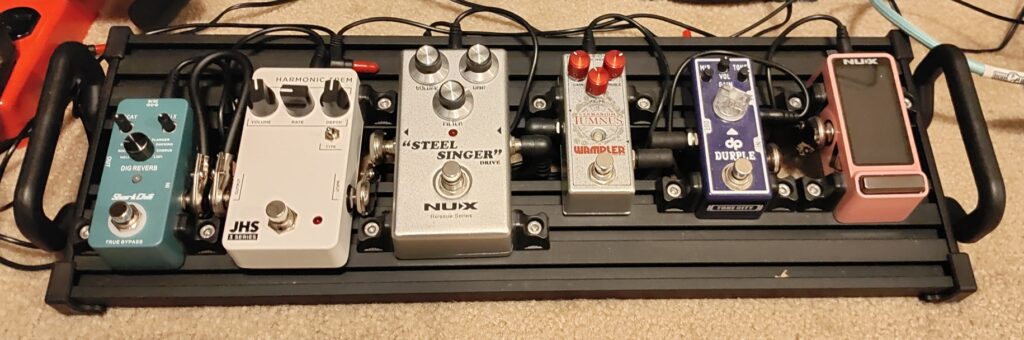
So the little board. The one I use at the casa. It’s also the one that I grab if I just need the basics. Sometimes I’ll call it my practice board even though I use it for more than that. It’s pretty similar to the big board. Just with smaller pedals on it.

First, we have the board. It’s a Guitto board off Amazon. It’s one of those rail types. I saw it on the cheap one day a few years ago, and I grabbed it. It’s the small one. I can fit 6 pedals on it so long as most of them are the mini-pedal size. I like the fact that I don’t have to have velcro on anything or use zipties. Weirdly, in the 3 or 4 years I’ve had it, the price hasn’t gone up. I paid $100 for it, and that’s what it still costs.

The board is powered by a Donner power supply I got on the cheap off Amazon when I bought the board. It’s advertised as an isolated power supply. No idea if it actually is, but I haven’t had any problems with it, and it was small enough to stick under the board. So I got it.

First pedal in the mix is my Nux Flow Tuner. In pink. That was half the reason I got it. It’s pink. I like pink. It does the job, and I haven’t had any issues with it. So it stays there. In my experience, headstock tuners don’t always work well. I had a regular church gig for a while where I stood not 2 feet from the loud end of a 9′ grand piano that never stopped playing. My headstock tuner would give me fits because my guitar was always resonating with whatever the piano was playing. It had trouble latching and hanging onto what I would play. So I prefer a pedal. This one does the trick.

The tuner goes into a Tone City Durple. I picked it up on a whim from Anderton’s a few years ago. I like the pedal. It’s a tube screamer without being a tube screamer. I’ve been told that it’s not a tube screamer, and is, in fact, Tone City’s take on the Lovepedal Kalamazoo. I’ve also read that the Kalamazoo is a take on specific amp that Gibson made when they were in Kalamazoo. No idea. I just know that I like the sound of the Durple, so it’s the first OD on this board.

That goes into my Wampler Tumnus. If you clicked that link, yes, it goes into the “alien silver” germanium Tumnus. I bought this one on a whim as well. Well after they were reporting that they had sold out of that pedal, I hit the page, it didn’t say it was sold out, so I clicked Buy. Seriously, it was late afternoon the day they were accidentally released early. Two months later (or whatever it was) one showed up on my doorstep. I figured, at worst, I could flip it if I didn’t like it or had buyer’s remorse.

Once it came in, I did a shootout between it and my other klones (inlcluding a v1 Tumnus and a KTR), and it won the shootout. Had it been a blind shootout, I don’t know what would’ve won because they all sounded super similar. But, playing that afternoon with them all, it sounded really, stinkin’ good!

The Tumnus goes into a Nux Steel Singer. It’s a Dumble-type OD that I really like. I got it off Reverb because I was trolling for an OD that wasn’t the usual TS, klone, or anything I already had. Came across the listing, made an offer that got it shipped to me for like $30. So I got it.

This one was originally part of the board when it was intended to be an afford-a-board, but I’ve liked it so well it has stayed. Especially for when I’m the house playing into a quiet amp, it’s my always-on pedal that gives just a little character to the tone. I tend to play pretty clean, and this pedal will drive just a touch when I dig in.

The newest pedal on the board, and it took me a while to get there, is my JHS 3-Series Harmonic Tremolo. I like a vibe-y pedal, and this board has been through several. Pedals I’ve had on it at some point: the MXR Univibe, the Lovepedal Pickle Vibe, the Kokko Vibe, the Mooer Shaky Jimi, and the Effects Bakery Japanese Butter Roll Vibe. All of them were ok pedals. The Kokko pedal added a real dark sound, but was otherwise ok.

It was my Black Friday purchase last year, so I got it for 25% off plus free shipping since I got it off Amazon. I’ve got the JHS pedal setup so it gives a swirly, swishy sound kind of similar to a vibe. At least it’s more vibe-y than it is trem-y to my ear. I really like it. It may eventually get swapped back to one of the others, but for now it’s staying.

Finally, the trem goes into the last pedal. It’s a Shark Chili Reverb. It could probably qualify as an afford-a-board pedal, but I got it after I had kind of moved on from that experiment. For the most part, to me, one reverb is as good as another. I can hear the difference in spring and hall reverbs, but outside that, I couldn’t tell you. It was cheap. It was small. It’s a reverb. That said, I really want to try one of those new Danelectro Spring Kings. I’ve got one of the big ones, and I’ve always liked it. So I want to try the mini-version of it. I just haven’t pulled the trigger yet.

So that’s it. The small board. Next week maybe I’ll do the big board. There’s a lot on it that’s really similar to what I have on the small board. It’s not identical by any stretch, but it probably just goes to show that we each hear a certain sound in our head, and that’s what we tend to navigate toward.

I Love Tube Screamers?

So I have a pedal on my board that I really like. It’s not a Tube Screamer. I’ve been told it’s a D-type. If you look at the ad-copy on the company website, it never mentions the word Dumble, but it, also, gives the impression that it was modeled after that type of amp. It’s the Nux Steel Singer. Heck, just the name of it makes you think it’s a D-type.

It’s my always-on pedal. You know the one. Since I primarily play at home, I can’t (or won’t) turn up the amp enough to get any good drive from it, so I have to use a pedal to get that basic grit. And that’s the pedal that I use for that. I like the way it sounds. It definitely would NOT be considered a transparent OD. It puts a definite color on the sound. But I like it. On my home rig (which I may talk about in the next post or so), it sits behind 2 other drive pedals. Weirdly, looking at the title of this post, neither or which are Tube Screamers.

But I have a thing for Tube Screamers. The first OD pedal that I got was a TS808 clone. I didn’t know it at the time. I just knew that I liked it. Then I got a couple of other ODs that were just kind of ok, but not the sound in my head. Then I got a TS9. And I liked it better than the TS808 clone. Then I found out about the same time that there were bunches of TS-type pedals out there and that SRV used one.

Now, being a fan of SRV, I decided I needed to start trying out all the TS-type pedals I could find. I think, at my peak, I had 15 of them. Expensive ones. Cheap ones. Ones that actually said “Tube Screamer” on them. I ended up getting rid of some of them. I’ve even bought others since then. And you know what? They all sound like Tube Screamers at the end of the day.

So back to the Nux Steel Singer. Like I said, I dig it! I like the sound. I can’t say that it sounds like a Dumble because I’ve never had a Dumble so that I could compare. Maybe it does. Maybe it doesn’t. I just know that I like the sound of it in the way that I use it.

So I thought it was really interesting when I saw the video below from the chaps at Anderton’s that came out a few weeks ago. Danish Pete has better ears than me. And, in a blind test, about 2:30 into the vid, he says that it has kind of a “Tube Screamery vibe.”

It’s not a Tube Screamer. It doesn’t have that super-pronounced mid-hump thing that they have, but he says it has that vibe. So maybe that’s why I like it. I don’t know. I’m going to have to go back in there and sit down and do a side by side and see. Maybe it’s just close enough to doing the TS-thing without actually doing it that it catches my ear.

Now as for the Tube Screamer love. I’m not sure if I love them or not. The weird thing is, if someone asked me what single OD pedal I would pick if I had to go with just one, I’d probably say either a TS or some TS-type pedal that I like. But both of my boards (the big one and the little one) have the same drives (or types of drives on them), and neither has a Tube Screamer.

Since I’ve been talking about the Nux Steel Singer, I’ll mention the little board first. I have 3 drives on both boards. I have a Tone City Durple (similar to the Lovepedal Kalamazoo), a Wampler Germanium Tumnus (a klone), and the Nux Steel Singer. On the big board, I have a Lovepedal Kalamazoo (the gold one), a Klon KTR (can’t get more klone than that), and a Warm Audio Warmdrive. The patch I use most with my Pod Go isn’t anything like either board. Go figure.

So, love them or hate them, I still have a bunch of TS-type pedals along with a TS9 and a TS-mini. I’ve never owned an actual TS808. But that’s fine because it seems all the clones are derived from that pedal. Maybe some day, if I haven’t already, I’ll talk about some of my favorite TS-types and why I like them.

What’s your favorite OD pedal?